Why radiators go cold and how to bleed them
Radiators cold at the bottom on Teesside? We explain why it happens, what you can do yourself, and when to call a heating engineer.

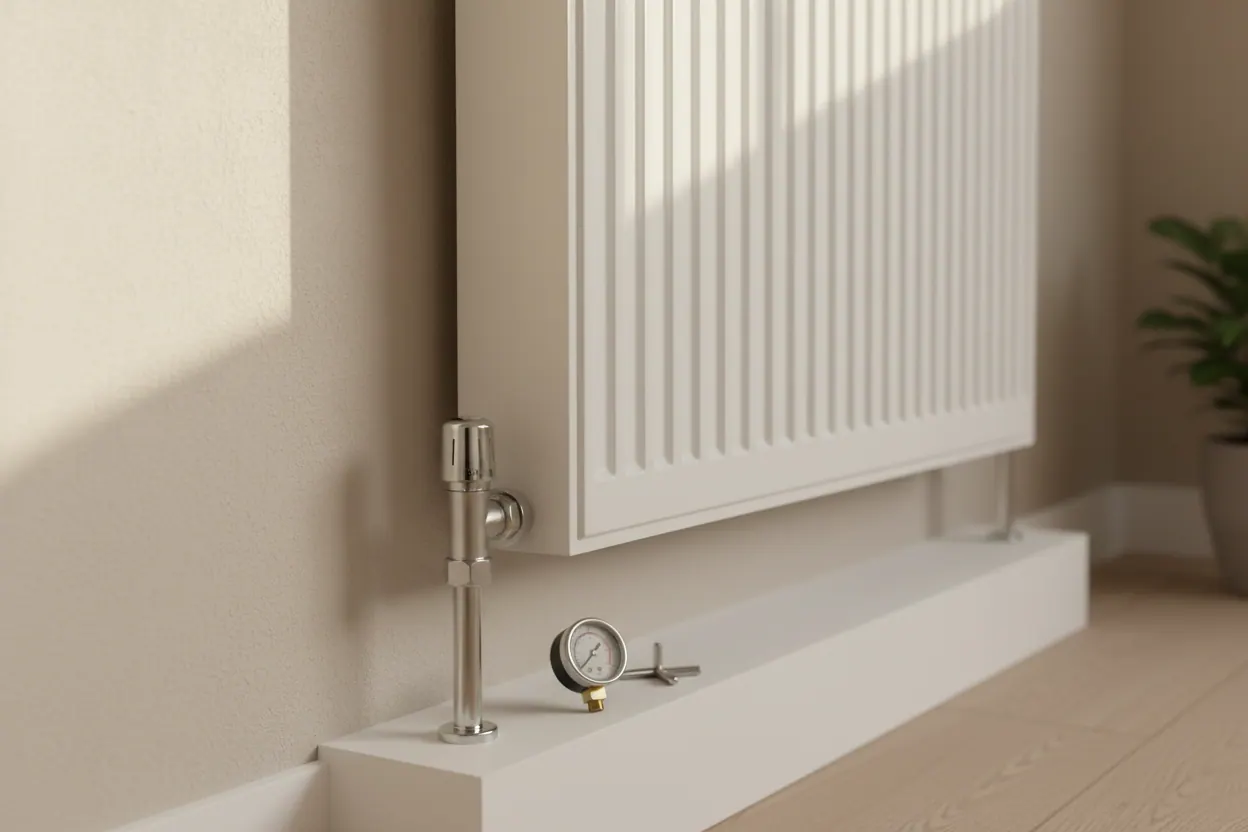
Why are my radiators cold?
A radiator that stays cold, or only warms in places, is one of the most common heating complaints. The good news is that some causes are simple to deal with yourself. The better news is that you can usually tell a lot from where the cold patch is.
Whether you are in Middlesbrough or elsewhere on Teesside, older terraces and newer estate homes can all have the same problem. Here is how to read the signs, what you can safely do, and when it is time to call a heating engineer.
Cold at the top, or cold at the bottom?
Cold patch at the top of the radiator. This usually points to trapped air. Air collects at the top and stops hot water filling the radiator. Bleeding the radiator normally sorts it.
Cold at the bottom, warm at the top. This often points to debris or sludge in the system settling at the bottom of the radiator and restricting flow. Bleeding will not fix it. This one needs a heating engineer to look at the system.
The whole radiator is cold. Possible causes include a closed or faulty valve, a problem with circulation or a fault elsewhere in the system. If several radiators are cold, the problem is probably not the radiator itself.
A working radiator should feel warm across its whole surface. A slight difference between top and bottom is normal, but a bottom section that is clearly cold while the top is hot is worth having checked.
Other causes of cold radiators
- A valve that is closed or stuck. Radiators have valves at both ends. If one is stiff or not opening fully, the radiator may not heat properly.
- An unbalanced system. Water has to be shared between all the radiators. If the system is out of balance, some get too much flow and others too little.
- Low boiler pressure. If pressure has dropped, several radiators can run cold.
- A circulation fault. If the pump is not moving water properly, many radiators can be affected at once.
If you suspect any of these, it is best to have an engineer look rather than adjusting valves or the system yourself.
How to bleed a radiator
If the cold patch is at the top, bleeding is a straightforward job most homeowners can do safely.
- Turn the heating on to find which radiators are cold at the top.
- Turn the heating off and let the radiators cool, so you are not dealing with scalding water.
- Use a radiator bleed key to open the bleed valve at the top corner of the radiator.
- Hold a cloth under the valve and turn the key slowly anticlockwise. A hiss means air is escaping.
- When a steady dribble of water appears, close the valve.
- Check your boiler pressure afterwards, because bleeding can lower it.
If the pressure has dropped, top it up using the filling loop exactly as your boiler manufacturer describes. If you are not sure how, do not guess. Ask an engineer.
What bleeding will not fix
If you bleed a radiator and the top warms up but the bottom stays cold, air is not the main problem. Debris in the system is more likely, and that is not something to try to force out yourself. Flushing a radiator or a system can go wrong if it is not done properly, for example by pushing debris towards the boiler. A heating engineer can assess what is happening and advise on the right approach.
When to call a heating engineer
Get the system checked if:
- Several radiators are cold at the bottom, not just one
- Boiler pressure keeps dropping after you top it up
- The system makes banging, gurgling or rumbling noises
- A radiator valve is leaking or will not turn
- Rooms are not warming up even though the heating is on
- You have bled the radiators and nothing has improved
These can all be signs of a fault that will get worse, especially once cold weather means the heating is working its hardest. See our central heating repairs and maintenance page, and our guide to why autumn matters for a boiler service.
A safety note
Radiator and heating problems are often not a gas issue, but the boiler is. Never remove a boiler casing or work on gas pipework, flues or boiler internals yourself. That is work for a Gas Safe registered engineer. If you smell gas, turn off the gas at the meter if it is safe to do so, open doors and windows, avoid switches and naked flames, and call the National Gas Emergency Service on 0800 111 999.
Frequently asked questions
Why is my radiator warm at the top but cold at the bottom? This often points to debris or sludge settling in the bottom of the radiator and restricting flow. Bleeding will not cure it, so it is worth having the system looked at.
Should radiators ever be cold at the bottom? Not noticeably. A working radiator should feel warm across its surface when the heating is on. A clearly cold bottom section means something is restricting flow.
Will bleeding my radiators fix cold spots? Only if the cold spot is at the top and caused by trapped air. For other cold spots, bleeding will not help, and it is worth having the system checked.
Why is my new radiator cold at the bottom? A new radiator can show the same problem if the existing system water carries debris from older parts of the system. If a new radiator is already cold at the bottom, the system should be checked.
If your radiators are not heating evenly in Middlesbrough or on Teesside, call us on 07710 444026 or use the enquiry form.